Wednesday, 5 June 2013

hari raya - the day of celebration

And finally, another major celebration…..

Hari Raya is known as "lebaran". Muslims celebrate this event and usually used the words such as "Selamat Hari Raya" or "Happy Eid" to greet the other people who celebrate it.

Hari raya Aidilfitri is a celebration where it is determined by the sign of new moon (Rukyah), before the next month on the Muslim calendar, Syawal.

The meaning of Hari Raya Aidilfitri is for thanksgiving and forgiving. Most of muslims go to the mosque, pray, and thanks to God to forgive their mistaken in the past. Besides that, Hari Raya aims to unite the whole family in order to gathering together with love, blessings, forgiveness, and also to renew the relationship with others. Therefore, they used the words, "Maaf Zahir dan Batin" or "I seek forgiveness (from you) physically and spiritually" to keep in touch with each other.

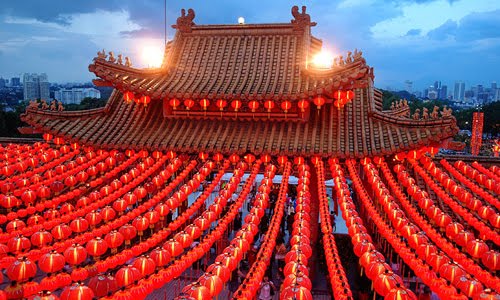
Hari Raya Aidilfitri is a day where Muslims win their fasting from dawn to dusk in a month before. During Hari Raya Aidilfitri, Muslims always decor their house with oil lamps lighting to greet the angels which is believe will come during the seven days foregoing the festival. It is always started with morning prayer in mosque then giving the zakat to support the development of the mosque. Then, it will be a cheerful day for children because they get money from elder people.

 It takes a month and focused in the first three days. During these three days, open-house will be held to
 welcome people from all races come and salute the event. There are a lot of food which is provided
 such as ketupat, cookies, and beef rendang and Muslims wear their traditional costumes. The dress for
 men is called baju melayu and women's are known as baju kurung or baju kebaya. Songket and batik
 are worn properly during this event.

Also, in Hari Raya, they will visit their ancestor's grave and clean up the grave, perform the recital of the Yasin and lift up tahlil (prayer) with the aims Allah will bless their ancestor and salvage them from the infliction in the grave.


figure 1 : poster of Hari Raya Aidilfitri


figure 2 : the celebration of Hari Raya with lights


figure 3 : food which always provided in Hari Raya


figure 4 : how people celebrate Hari Raya


figure 5 : What people do in Hari Raya 


References :

terengganutourism, n.d. Hari Raya. [Online] Available at:
http://www.terengganutourism.com/festivals.htm [Accessed 5 June 2013].

Malaysiatrulyasia, 2013. Hari Raya Aidilfitri. [Online] Available at: http://www.tourism.gov.my/en/Master/Web-Page/Events-n-Festivals/2013/8/Hari-Raya-Aidilfitri?evty=2013&evtm=8 [Accessed 5 June 2013].

JustEnglishExplorer, 2013. Hari Raya Aidilfitri. [Online] Available at: http://explorer.justenglish.com/magazine/special-event/hari-raya-aidilfitri [Accessed 5 June 2013].

Picture links :

http://ramadhan.701pages.com/articles/hari-raya-aidil-fitri-activities-in-malaysia-88.html

http://shutterspeech.net/10decisivetravels/?p=648

http://cpteh.blogspot.com/2012/08/selamat-hari-raya.html


- Nathania


Monday, 3 June 2013

Chinese New Year

Continuing from the previous post, here is about Chinese New Year...

Chinese New Year:

Chinese New Year falls on the first day of the year according to Chinese Lunar Calendar, and ends at the fifteenth day, which is “Chap Go Meh” in Hokkien, or we call it as Lantern Festival.

The origin of Chinese New Year was started of with a mythical beast named “Nian” (Figure 1). Every year of the New Year, “Nian” will always come out from the cave and attack the villagers nearby. So, many villagers were afraid of it, but they do not know what to do. One day, there is one old man in the village states that “Nian” was afraid of the colour Red and the loud voice of firecracker and drums. So the villagers do as what the old man tell them, decorate their house with red paper and scrolls. When “Nian” comes to the village again, the villager starts to play the drums and lit up the firecracker. Just as the old man said, “Nian” run away with fear and never come back to this village again. Everyone was so happy that they recognize this as “passing of “Nian”, and also the same as celebrating New Year. From this incident, Red consider as the colour, which will bring good luck.
Figure 1: "Nian Beast"

Before Chinese New Year, the family will decorate and clean their house by hanging red lantern and scrolls (Figure 2). When it is Chinese New Year eve, the whole family members gather around and have meals together. Then on the day itself, adults will insert some money in “Ang Pao” (Figure 3), which is also means Red Packet, and give it to the children. After receiving red packet from the elder, the family will visit other friend’s house and greet them (Figure 4). Besides than visiting friends, there will be also tradition performance on the street or a certain shop, which is lion dance (Figure 5) and dragon dance (Figure 6).


Figure 2: Red Lanterns


Figure 3: “Ang Pao”


Figure 4: Chinese New Year house visit           


Figure 5: Lion Dance


Figure 6: Dragon Dance


While celebrating Chinese New Year, there are some taboos during these days. One of the taboo is, do not sweep the floor on the actual day itself. As according to the traditional, it is to believe that sweep the floor will sweep away all the good luck in that family. The other taboo is, avoid saying rude words and wearing the colour black. As black colour is consider as the colour of unlucky, and it is wear during funeral. Number “4” also will be avoided, as the pronunciation of 4 in Mandarin which is “Si”, has the same pronunciation as “death” in Mandarin.

References:
Lisa Chiu. 2013. History of Chinese New Year. [ONLINE] Available at:http://chineseculture.about.com/od/chinesefestivals/a/ChineseNewYear.htm. [Accessed 03 June 13].

Education2. Unknown. Taboos and Superstitions of Chinese New Year. [ONLINE] Available at:http://education2.uvic.ca/Faculty/mroth/438/china/taboos.html. [Accessed 03 June 13].

Education2. Unknown. Chinese New Year. [ONLINE] Available at:http://education2.uvic.ca/Faculty/mroth/438/china/chinese_new_year.html. [Accessed 03 June 13].

HanBan. 2013. Chinese New Year Taboos and Customs. [ONLINE] Available at:http://www.hanban.com/chinese-culture/chinese-taboo/chinese-new-year-taboos-customs.html. [Accessed 03 June 13].


- Adriana

Deepavali - the celebration of lights


For our assignment, instead of doing the Ramadan, we will be doing an advertisement based on racial unity. For that, our concept will be on the major celebrations in Malaysia. We started by doing research on our subject

So here is Deepavali..


Deepavali (also known as Diwali) is a five days festival occurs on the fifteenth day of Kartika. It usually takes place eighteen days after Dusshera, which is around October and November and it is to honors Lakshmi, the goddess of wealth. Diwali signifies the renewal of life, and it is common to wear new clothes on the festival day.

  The word Deepavali means “ Rows of light” and for that, small lamp oils and candles (diyas) are lit to help Lakshmi find her way to people’s home. Also, houses are cleaned, houses decorated with fancy lights, Rangoli (usually in the pattern of lotus flower) are drawn on the floor and there will also be displays of fireworks. This festival is always accompanied by the exchange of sweets and gifts.

Rangoli decorated on the floor

http://1.bp.blogspot.com/-OAJtT60CYUM/Ti8WmQtb9fI/AAAAAAAAAMk/d_XcPpXq7qQ/s1600/Rangoli2.jpg


  According to the Indian culture, wealth is not viewed as a corruptive power but a reward to those who have done a good deed in the past live.

In North India, Diwali celebrates the homecoming of Rama to Ayodhya after the defeat of Ravana and his coronation as king. On the other hand, in Gujarat, the festival honors Lakshmi, the goddess of wealth and in Bengal, it is associated with the goddess Kali.

  On the second day of the festival, the goddess of strength, Kali is worshipped. This day is more focus to abolishing laziness and evil. The third, lights and lamps are lit brightly in every home. The lamp symbolizes knowledge and encourages reflection upon the purpose of each day of the festival. Old business accounts are settled and new books are open. This encourages the people to remove their anger, hate and jealousy from their lives. Lastly on the fifth day, an ancient Indian king, Bali, was recalled. He destroyed the centuries old philosophies of the society. However, he is remembered as a generous person and thus, this day focuses on seeing the good of others, including the enemies.

The festival of lights

 http://www.abinesh.com/delirium/wp-content/uploads/2010/11/Shubh_Deepavali_Wishes-Diwali-161_big.gif

References:


- Maisarah


Sunday, 2 June 2013

Types and forms of advertising

Our research on advertising...


There are different types of way to advertise product. They are print advertising, broadcast advertising, billboard advertising and advertising options In film promos celebrity endorsements, cross promotions, merchandise Games (Mobile and computer), covert advertising.


Print advertising are newspapers, magazines, brochures, fliers newspaper media facts newspapers.


Broadcast advertising television, radio, digital (internet + mobile), broadcast media facts. Broadcast advertising is a very popular advertising medium that constitutes of several branches like television, radio or the Internet.

Reference list:
Slideshare, n.d.. Types and forms of advertising. [online] Available at:
(Accessed 3 June 2013)

-Mingfen


Video remaking ideas

There are a few things that we could redo the video.
We can choose 3 different scenarios from the options below.

1. Do not eat, drink and smoke in front of Muslims during Ramadan.
2. Abstain from cursing and letting your Muslim friend curse.
3. Calm your Muslim friend down when they get furious as this breaks their fast.
4. Avoid display of affection in public.
5. When a muslim friend invites for iftar, try not to refuse.
6. Avoid wearing any revealing clothes.
7. Avoid playing loud music.

Overall advertisement should not be more than 1 minute long.

- by Rui

Brief about Advertisement


2011 Ramadan television advertisement was chosen for our assignment. It is a controversial series of advertisements airing on 8TV, Astro Channel 708 to mark the Holy month of Ramadan in the ninth month of Islamic Lunar Calendar. During Ramadan, Muslims must abstain themselves from food and drinks to show their devotion to their religion. There are also many food stalls set up in various locations across the country, the Ramadan bazaars. This gives the opportunity to Malaysians of other faiths to tour the food stalls.
The Ramadan bazaars, now evolved into the affectionate term ‘pasar Ramadan’ or ‘param’, for short, is an annual gathering of foodstalls offering food for ‘iftar’ or ‘buka puasa’ for fasting Muslims but is open to all.
Klang Valley’s very own Top 10 Ramadan bazaars had been selected by Malaysian Digest where each one has its very own specialty to crave for. The following are the photos of bazaar Ramadan in Klang Valley, Kuala Lumpur, Malaysia.


The religious that Muslim believe in not only affect themselves in behaviour by fasting every ninth month in Islamic Lunar Calendar and open bazaar at same certain place and time. It affects culture Malaysian with other faith to gather together at bazaar Ramadan every ninth month. Different faith or religious or races, gather together at the same place, at the same time. The food stalls set up in Malaysia do affect the culture of Malaysian. It is important to behave properly at the bazaar Ramadan. 

The food stalls set up in Malaysia do affect the culture of Malaysian. It is important to behave properly at the bazaar Ramadan.
However, there were many complaints about this advertisement about non-Muslim especially the Chinese not knowing how to respect other’s religion. Then, on 2nd August 2011, media company, Media Prima owned 8TV pulled out the public service announcements (PSA) off the air after the growing criticism for stereotyping Chinese behavior during the fasting month.  The advertisements in YouTube also had been removed. The next day, 3rd August 2011, this controversial series of advertisements were announced in Singapore with MEDIACORP Channel 5.


 Reference list:

Malaysiandigest, 2012. Klang Valley's Top 10 Ramadan Bazaars. [Online] Available at:


- Mingfen

- Edited by Rui